

Concerns about chemical exposure in everyday products have become harder to ignore. From household substances and medications to cosmetics, personal care items, and other consumer goods, more people are paying attention to product safety, warning labels, and the long-term risks associated with hazardous materials. That broader public conversation makes one reality especially important: accidental poisoning remains a major cause of unintentional injury death in the United States, even though it often receives far less attention than car crashes, falls, or firearm-related incidents.
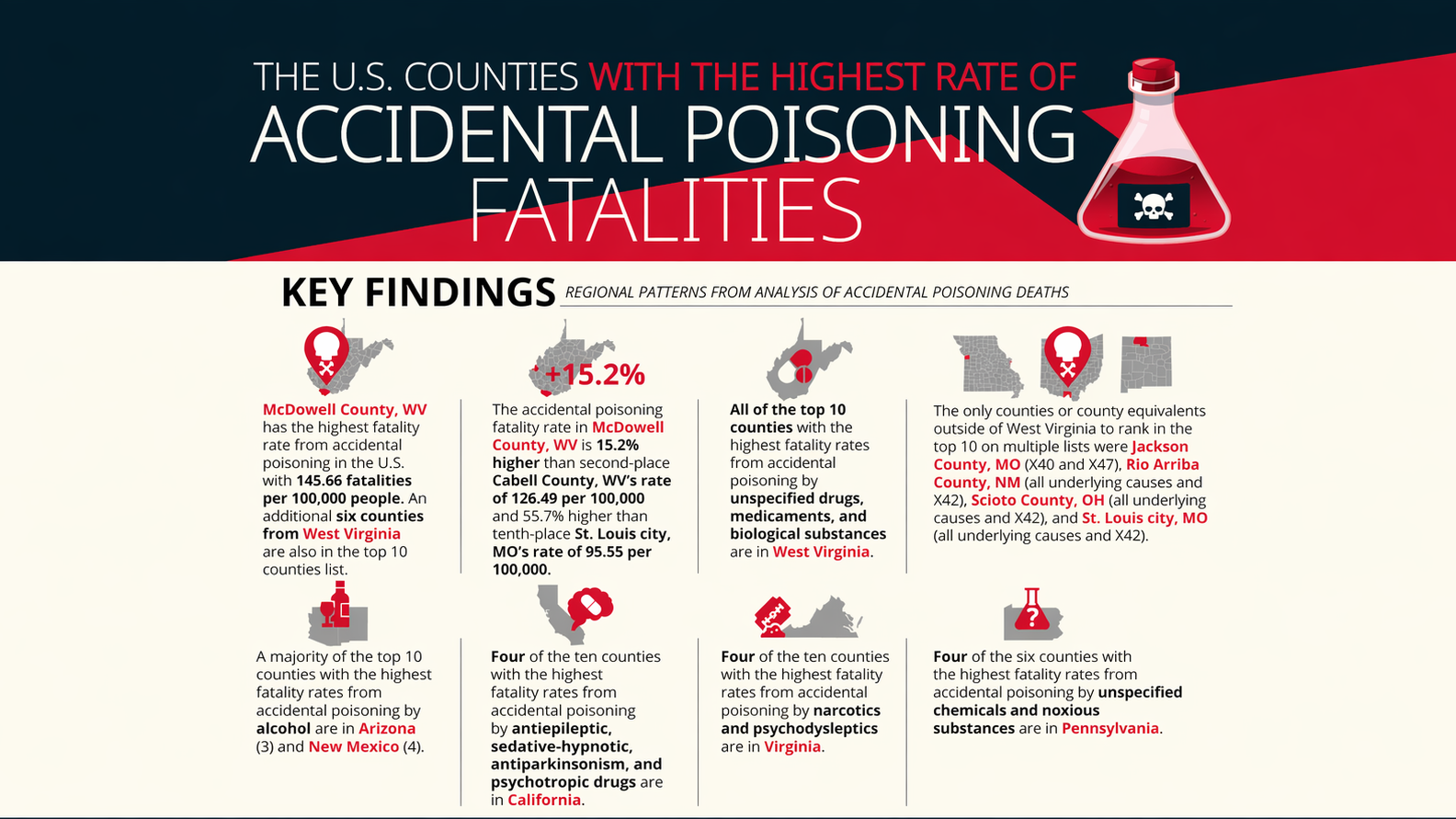
In our new study, Sadaka Law analyzed mortality data from CDC WONDER to identify the U.S. counties with the highest fatality rates from accidental poisoning and exposure to noxious substances. The findings revealed troubling patterns nationwide and in New Jersey. McDowell County, West Virginia, ranked first in the country at 145.66 deaths per 100,000 residents. In New Jersey, Atlantic County had the highest overall accidental poisoning fatality rate, at 59.77 per 100,000 residents.
For families in New Jersey and across the country, these findings are more than statistics. They reflect the real-world consequences of dangerous exposures involving drugs, chemicals, hazardous materials, and other substances people may encounter in homes, workplaces, and consumer products.
That context matters because accidental poisonings do not happen in a vacuum. As consumers pay closer attention to chemical risks in beauty products, household substances, and other everyday goods, this data offers a broader view of how dangerous exposures can become fatal. While not every poisoning death involves a defective product or legal claim, the findings show why safety, labeling, and prevention still matter.
For Sadaka Law, the study is also important from a product liability and injury perspective. Some accidental poisoning deaths may raise serious questions about unsafe consumer products, inadequate warnings, toxic chemical exposure, dangerous conditions, or other preventable hazards. When a fatal exposure involves a product, substance, or environment that may not have been reasonably safe, families may be left asking not only what happened, but whether more could have been done to prevent it.
Why Accidental Poisoning Demands More Attention
Poisonings continue to cause fatal harm in communities across the country, but the risks are often less visible than other accidental causes of death. As our study explains, these exposures can involve prescription medications, over-the-counter drugs, alcohol, narcotics, pesticides, household cleaners, industrial solvents, and other hazardous chemicals.
The study also notes that some of the most frequently reported poison exposures involve painkillers, household cleaning substances, antidepressants, cardiovascular drugs, and cosmetics or personal care products. Among children five and under, household cleaners and cosmetics are among the most common exposures.
Where Accidental Poisoning Fatality Rates Are Highest Nationwide
Our analysis revealed several national patterns worth noting. Most notably, West Virginia appears repeatedly at the top of the national rankings. In addition to McDowell County claiming the highest overall fatality rate, six other West Virginia counties appeared in the top 10, along with Scioto County, Ohio, and Rio Arriba County, New Mexico.
We also found that all 10 counties with the highest fatality rates from accidental poisoning by other and unspecified drugs, medicaments, and biological substances were located in West Virginia. McDowell County again ranked first in that category, followed by Logan, Raleigh, Cabell, Wyoming, Wayne, Mingo, Boone, Mercer, and Lincoln counties.
Other regions also stood out in specific poisoning categories. Lake County, California, had the highest fatality rate for accidental poisoning by antiepileptic, sedative-hypnotic, antiparkinsonism, and psychotropic drugs at 30.65 per 100,000. St. Louis, Missouri, ranked first for accidental poisoning by narcotics and psychodysleptics at 73.81 per 100,000, while four Virginia localities also appeared in the top 10 for that category. Apache County, Arizona, ranked first for accidental alcohol poisoning at 24.29 per 100,000.
For accidental poisoning by other and unspecified chemicals and noxious substances, Carbon County, Pennsylvania, ranked first, and four of the six counties with available data were in Pennsylvania.
Taken together, these findings show that accidental poisoning is not a one-size-fits-all problem. The counties with the highest fatality rates differ depending on the substance involved, which suggests that local conditions, exposure patterns, and public health challenges may shape how these deaths occur. For families trying to make sense of a poisoning death, that distinction matters. The risks can look very different depending on the type of exposure involved.
What Families Can Take Away From This Study
One of the most important takeaways from our study is that it does not treat poisoning deaths as one broad, abstract statistic. Instead, we broke the issue down by underlying cause of death using ICD-10 codes X40 through X49. That approach helps distinguish fatalities involving nonopioid pain relievers, psychotropic medications, narcotics, alcohol, gases and vapors, pesticides, solvents, and other hazardous chemicals.
That level of detail matters because not all poisoning cases raise the same public health concerns or the same legal questions. A fatal narcotics overdose presents different issues than an unintentional exposure to carbon monoxide, a pesticide, a contaminated product, or a toxic chemical in the workplace.
For Sadaka Law, breaking the data down this way helps clarify the different risks that may be involved in a fatal poisoning and the questions families may need to ask after a loss.
What the Data Shows in New Jersey
Looking only at New Jersey counties, Atlantic County ranked first overall, with an accidental poisoning fatality rate of 59.77 per 100,000 residents and 967 deaths from 2018 through 2023. It was followed by Camden County at 56.65, Cumberland County at 55.92, and Salem County at 55.10. Cape May, Gloucester, Essex, Ocean, Mercer, and Burlington counties also made the top 10.
We also broke the New Jersey data down by underlying cause of death, which revealed several notable county-level patterns.
- Gloucester County had the highest rate in New Jersey for accidental poisoning involving antiepileptic, sedative-hypnotic, antiparkinsonism, and psychotropic drugs, at 1.28 per 100,000, which was 52.4% higher than the next highest county in the state.
- Atlantic County ranked first in New Jersey for accidental poisoning by narcotics and psychodysleptics, with a rate of 42.71 per 100,000. Cumberland and Camden counties followed.
- Salem County ranked first in New Jersey for accidental poisoning by other and unspecified drugs, medicaments, and biological substances, with a rate of 21.15 per 100,000. Camden, Gloucester, Cape May, Mercer, Sussex, Atlantic, Warren, Cumberland, and Monmouth counties also appeared in that top 10.
- In the alcohol category, Union County and Bergen County had the highest rates in the state, at 1.65 and 1.54 per 100,000, respectively.
These findings also show how accidental poisoning deaths are affecting communities across New Jersey in measurable ways. For families in this region, the data makes clear that this is not an isolated problem affecting only a few communities.
When a Poisoning Death May Raise Legal Questions
Not every accidental poisoning death leads to a legal claim. But some do raise serious questions about whether the death was truly unavoidable.
As we explain in the study, these deaths may sometimes be linked to unsafe housing conditions, workplace exposures, faulty or hazardous products, inadequate warnings, regulatory failures, or other forms of negligence. For families facing that kind of loss, the most important questions are often straightforward: What happened, could it have been prevented, and should someone be held accountable? In some cases, those questions may warrant a closer legal review.
Where These Findings Come From
We based our rankings on National Center for Health Statistics mortality data available through CDC WONDER. The analysis reviewed all-ages deaths by underlying cause from 2018 to 2023 and calculated fatality rates per 100,000 residents to allow for fair comparisons across counties with different population sizes. Only counties or county equivalents with populations of at least 100,000 were included.
Some categories were excluded from the top-10 analysis because the fatality rates were considered unreliable due to low death counts or because the data was suppressed for confidentiality reasons. That matters because it shows the rankings were not built on anecdotes. They were based on a defined and transparent review of federal mortality data. These rankings reflect our analysis and may vary depending on methodology, time frame, and inclusion criteria.
Behind these rankings are families dealing with deeply personal loss. They may be trying to understand how the poisoning happened, whether it could have been prevented, and what steps to take next.
Schedule a Consultation With Sadaka Law
If you lost a loved one in a poisoning incident and have questions about what happened or whether negligence may have played a role, Sadaka Law may be able to help. We invite you to use our online contact form to schedule a consultation and talk through your rights and options.
Disclaimer: This article is for informational purposes only and does not constitute legal advice or create an attorney-client relationship. If you are seeking legal advice, please contact our law firm directly.